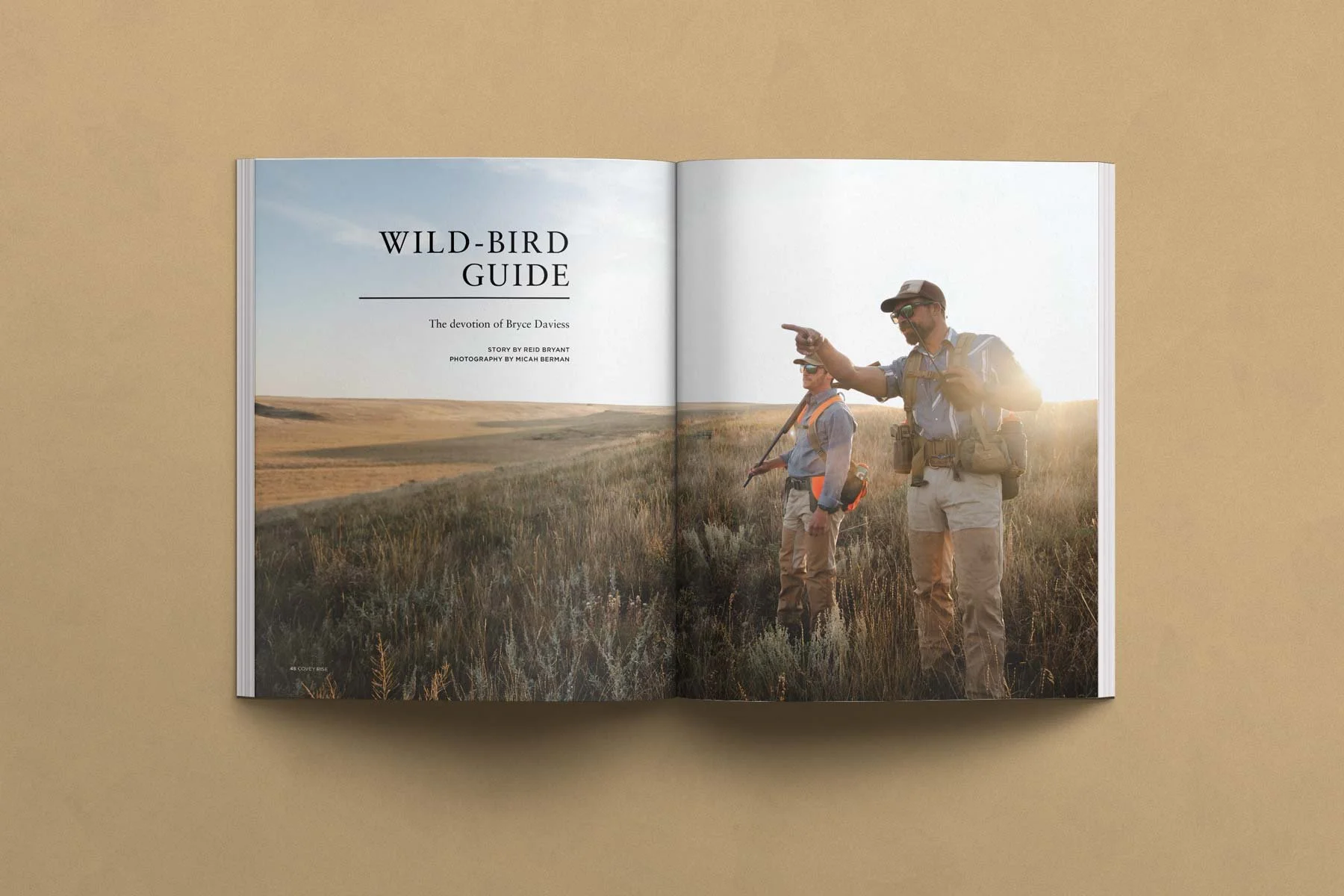
Wild-Bird Guide
In 2022, at winter’s end, I joined the bird hunters’ pilgrimage south and west to the oak savannas around Patagonia, Arizona. Each year, as upland seasons close across the north, the faithful gather here to honor Mearns quail and pointing dogs. A visit to Patagonia feels like a homecoming, not literal but spiritual. At the Wagon Wheel Bar, the Steak Out in Sonoita, or any pull-off in the El Coronado National Forest, you’ll find dog boxes and kindred souls, provided you see bird hunting as communion rather than competition.
One evening, a group of us met for dinner; guides, hunters, and dog people from near and far, old friends and new. By late evening the steaks were bones and gristle, the glasses half empty. We had pulled two tables together to accommodate, but one chair sat empty. I checked my phone for word from Bryce Daviess. He’d been guiding that day near the New Mexico line but hoped to join us. As if on cue, the door opened and Bryce walked in, brush-beat and dusty, the outline of sunglasses pale against his tanned face. He shook hands, took the empty chair, and ordered a beer.
Talk drifted from covey rises and beloved guns to dogs and their accumulated scars. When we finished, it was late. Some would start the long drive home in the morning; others would return to the hills. I asked Bryce where he was staying. He shrugged. “Back to the ranch,” he said. “I guide again tomorrow and still need to sort lunches and air the dogs.”
It was near ten on a weeknight. Bryce had been up since dawn, feeding and watering his string, gassing the truck, guiding a long day, cleaning birds, then driving two hours to see us. Now he was heading back through the dark borderlands for a few hours of sleep before doing it again.
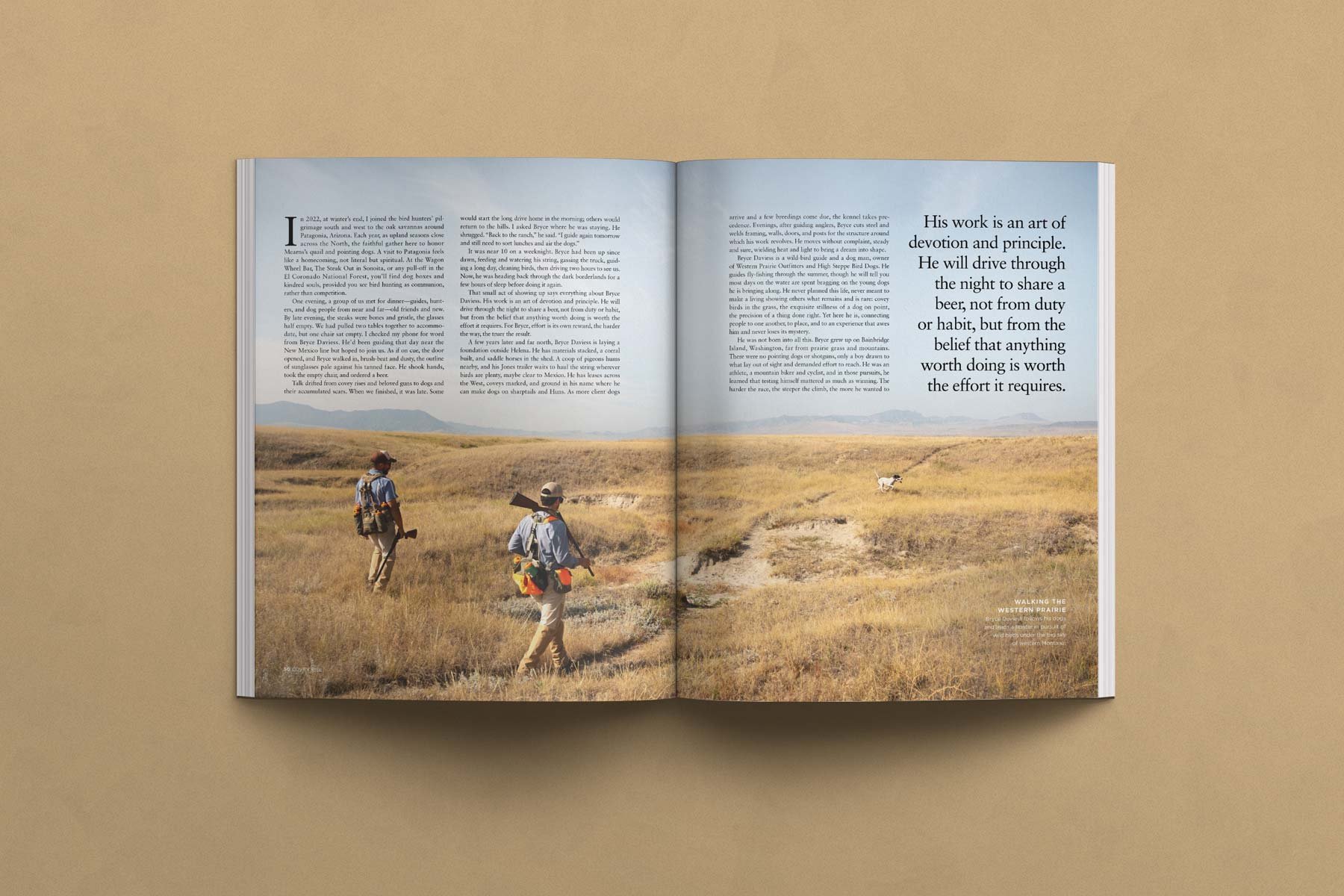
That small act of showing up says everything about Bryce Daviess. His work is an art of devotion and principle. He will drive through the night to share a beer, not from duty or habit but from belief that anything worth doing is worth the effort it requires. For Bryce, effort is its own reward; the harder the way, the truer the result.
A few years later and far north, Bryce Daviess is laying a foundation outside Helena. He has materials stacked, a corral built, and saddle horses in the shed. A coop of pigeons hums nearby, and his Jones trailer waits to haul the string wherever birds are plenty, maybe clear to Mexico. He has leases across the West, coveys marked, and ground in his name where he can make dogs on sharptails and huns. As more client dogs arrive and a few breedings come due, the kennel takes precedence. Evenings, after guiding anglers, Bryce cuts steel and welds framing, walls, doors, posts for the structure around which his work revolves. He moves without complaint, steady and sure, wielding heat and light to bring a dream into shape.
Bryce Daviess is a wild bird guide and a dog man, owner of Western Prairie Outfitters and High Steppe Bird Dogs. He guides fly fishing through the summer, though he will tell you most days on the water are spent bragging on the young dogs he is bringing along. He never planned this life, never meant to make a living showing others what remains wild and rare: covey birds in the grass, the exquisite stillness of a dog on point, the precision of a thing done right. Yet here he is, connecting people to one another, to place, and to an experience that awes him, and never loses its mystery.
He was not born into all this. Bryce grew up on Bainbridge Island, WA, far from prairie grass and mountains. There were no pointing dogs or shotguns, only a boy drawn to what lay out of sight and demanded effort to reach. He was an athlete, a mountain biker and cyclist, and in those pursuits, he learned that testing himself mattered as much as winning. The harder the race, the steeper the climb, the more he wanted to see what he was made of. He says he has always been fiercely competitive, though he says it softly, as if that drive is directed less against others than toward his own hogh standard. He likes to do things, then do them better, knowing that the pursuit of perfection is a myth.
In college at University of Montana, Bryce befriended John Cuddy, who was running VO2 max testing in the university’s Exercise Science Lab. Both were drawn to endurance sports and the mountains, but John had also gotten a GSP pup named Tana. In obsessive fashion he trained her on wild birds, and Bryce followed along, watching instinct turn to purpose. Seeing that dog work unlocked something in him, a fascination that would reshape his life.
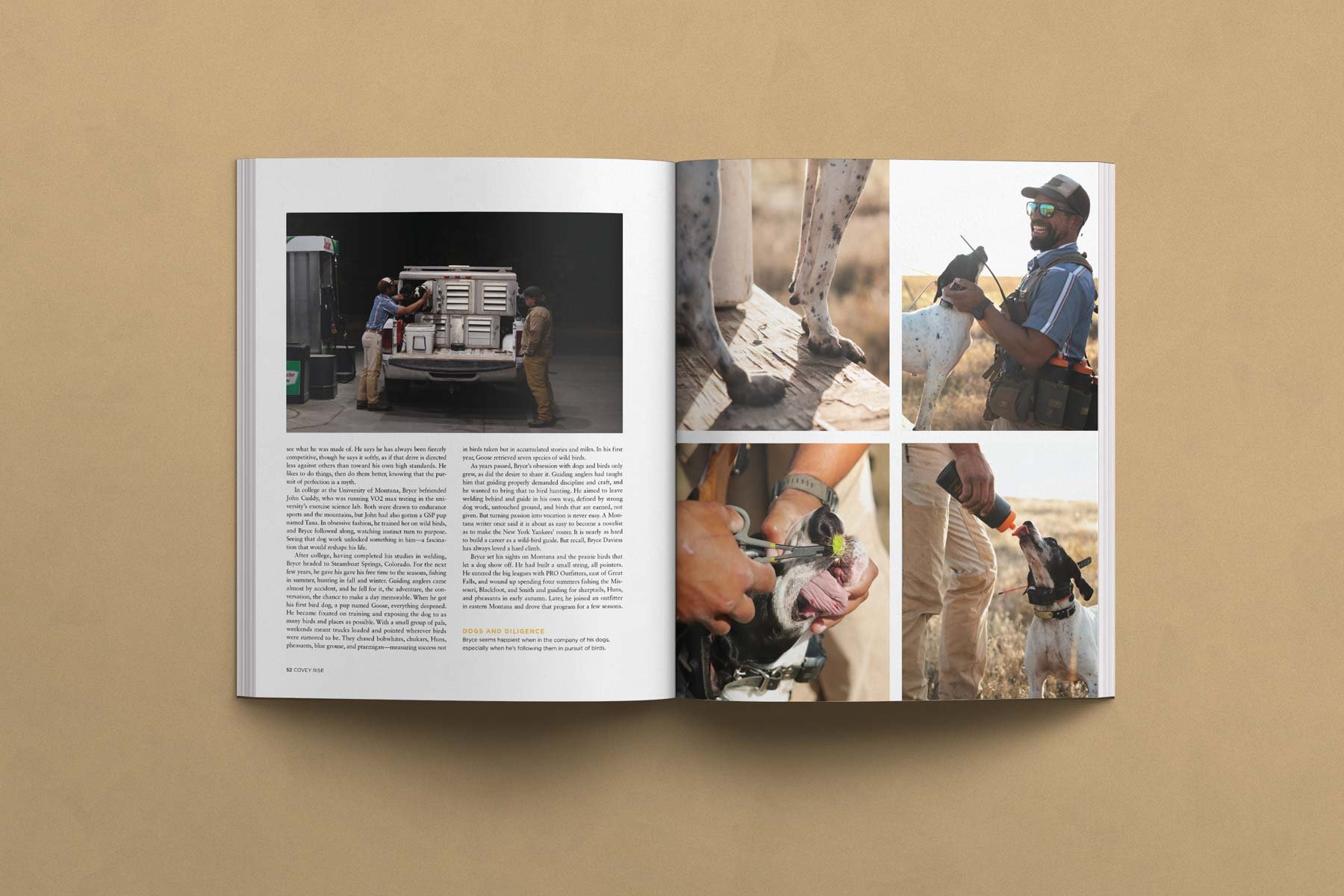
After college he trained as a welder and headed to Steamboat, Colorado. For the next few years, Bryce gave his free time to the seasons, fishing in summer, hunting in fall and winter. Guiding anglers came almost by accident, and he fell for it, the adventure, the conversation, the chance to make a day memorable. When he got his first bird dog, a pup named Goose, everything deepened. He became fixated on training and exposing the dog to as many birds and places as possible. With a small group of pals, weekends meant trucks loaded and pointed wherever birds were rumored to be. They chased bobwhites, chukars, huns, pheasants, blue grouse, and ptarmigan, measuring success not in birds taken but in accumulated stories and miles. In his first year, Goose retrieved seven species of wild birds.
As years passed, Bryce’s obsession with dogs and birds only grew, as did the desire to share it. Guiding anglers had taught him that guiding properly demanded discipline and craft, and he wanted to bring that to bird hunting. He aimed to leave welding behind and guide in his own way, defined by strong dog work, untouched ground, and birds that are earned, not given. But turning passion into vocation is never easy. A Montana writer once said it is about as easy to become a novelist as to make the New York Yankees’ roster. It is nearly as hard to build a career as a wild bird guide. But recall, Bryce Daviess has always loved a hard climb.
Bryce set his sights on Montana and the prairie birds that let a dog show off. He had built a small string, all pointers. He entered the big leagues with PRO Outfitters east of Great Falls, and wound up spending five summers fishing the Missouri, Blackfoot, and Smith, and guiding for sharptails, huns, and pheasants in early autumn. Later, he joined an outfitter in Eastern Montana and drove that program for a few seasons. He rounded out the guide work by training dogs for his own use and his clients’, migrating south toward the desert each winter to guide for other outfitters and learn the ground. He explored leases in Mexico for elegante quail and Mearns, Nevada for chukars and huns, then returned to Montana each spring. None of it came easy, but Bryce would have it no other way.
The leap into self-employment as a wild bird guide is never made lightly. There are long days, solitary drives, and quiet doubts. As Bryce rounded out his year guiding and training dogs, he weighed the costs: a wild bird guide builds a life on shifting ground. Dogs to train and feed, leases to secure, clients to find and keep; scouting days, short seasons, migrations from state to state in search of open country and willing birds; cold mornings in the cab, gas station dinners, and the knowledge that each season rests on nature’s whim. One late frost, a dry spring, a pasture grazed too hard, and a year’s work can vanish like smoke. Yet all of this in service of a singular purpose: to show people something intrinsically valuable, and rare. It is an ascetic life, a quest for purity through discomfort, ultimately an act of altruism. And Bryce would have it no other way.
So here he is, building a kennel outside Helena. It’s summer. When fall comes, he will turn to the Montana prairies, filling days showing people what a pointer can do and how an upland hunter should respond. He will ask that clients not shoot bumped birds, and he will demand staunch honors from his backing dogs. He is not in this to accept anything less than exceptional. As the autumn advances, he will traverse the country with a loaded trailer, stopping in all the places that he's learned to hold wild birds. On the passages between he will pull of the highway, stake out dogs on empty ground, sleep beside them on a cot after a gas-station dinner, and rise before dawn to air out some puppies and roll on again.
Because ultimately this life is a privilege, one Bryce Daviess knows well. For him, wild birds are the proving ground for dogs, guides, and people who call themselves bird hunters. Wild birds afford Bryce the chance for authenticity and truth, and a mastery that cannot be faked.
Bryce Daviess will never measure his success as a guide in a tailgate pile of dead birds. That would be too easy. He will measure it in effort, in how closely he lives by his ethos, in how he tests himself daily to be better. He loves this life… costly, risky, solitary, and hard. In difficulty lies beauty, the purest work of all, done for no applause.
If it were easy, everyone would be doing it.
First Published in Covey Rise Magazine