The Shots You Don’t Take


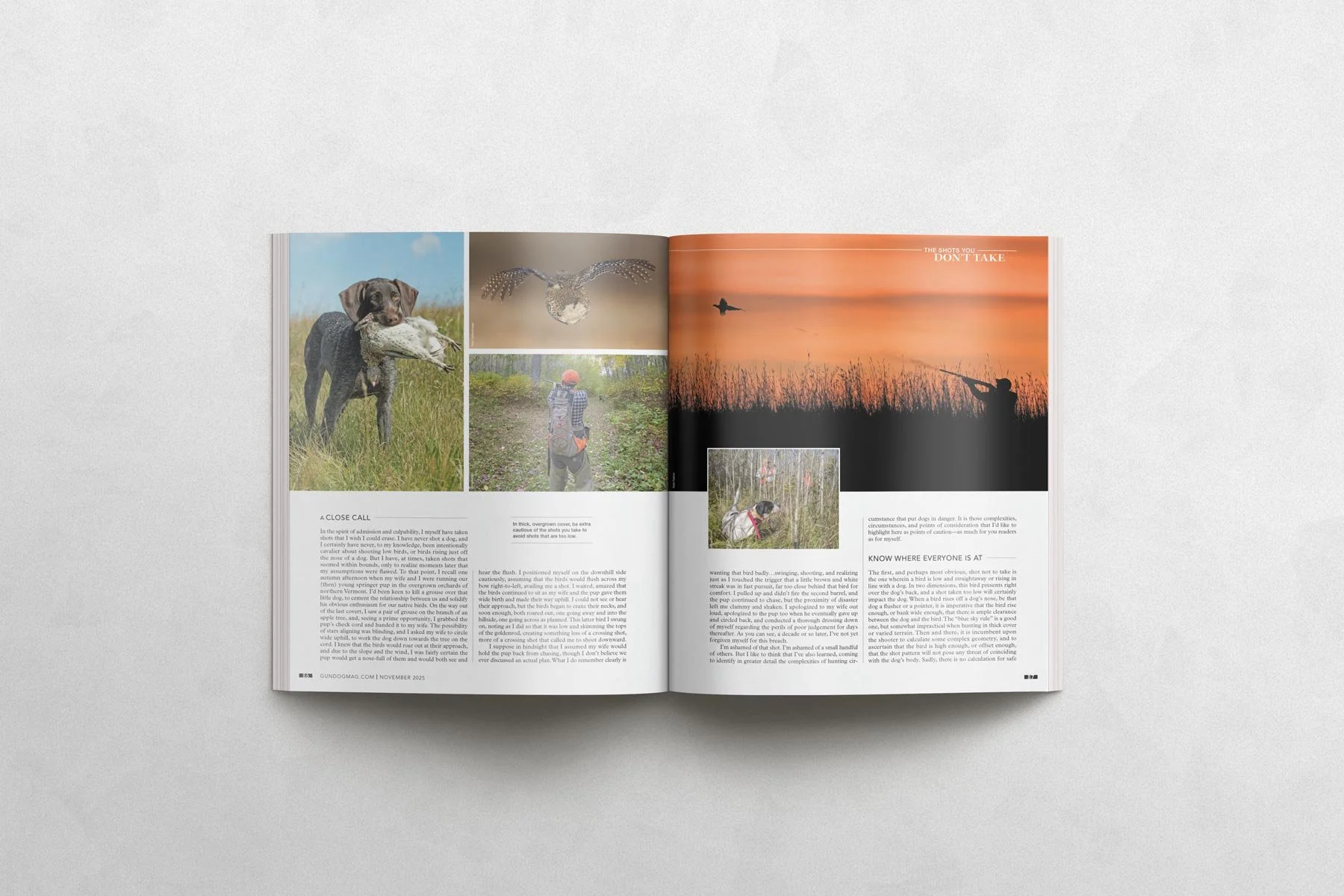

As the title suggests, what follows is an opinion piece about those shots which a hunter simply should not take. There are several ways to spin this narrative: there are shots that should likely not be taken from a standpoint of etiquette, as “poaching” a partner’s bird has a way of straining a friendship or, worse yet, injecting a culture of competition into a day’s hunting that results in rushed, ill-executed, or unsafe shots; there are shots executed too quickly and too close, ones that reduce a beautiful piece of game meat into an unsalvageable pulp of flesh and feathers; other shots, taken at questionable distance, lack the lethality to cleanly drop a bird, introducing to the game a degree of waste and suffering that should not be considered palatable to a conscientious shotgunner. And then there are those shots that put fellow hunters, guides, or dogs in physical danger. Sadly, it is often the dogs that realize the horrific impact of the shots that should not be taken, and that cannot be taken back.
In the spirit of admission and culpability, I myself have taken shots that I wish I could erase. I have never shot a dog, and I certainly have never, to my knowledge, been intentionally cavalier about shooting low birds, or birds rising just off the nose of a dog. But I have at times taken shots that seemed within bounds, only to realize moments later that my assumptions were flawed. To that point, I recall one autumn afternoon when my wife and I were running our (then) young springer pup in the overgrown orchards of northern Vermont. I’d been keen to kill a grouse over that little dog, to cement the relationship between us and solidify his obvious enthusiasm for our native birds. On the way out of the last covert I saw a pair of grouse on the branch of an apple tree, and, seeing a prime opportunity, I grabbed the pup’s check cord and handed it to my wife. The possibility of stars aligning was blinding, and I asked my wife to circle wide uphill, to work the dog down towards the tree on the cord. I knew that the birds would roar out at their approach, and due to the slope and the wind, I was fairly certain the pup would get a nose-full of them, and would both see and hear the flush. I positioned myself on the downhill side cautiously, assuming that the birds would flush across my bow right-to-left, availing me a shot. I waited, amazed that the birds continued to sit as my wife and the pup gave them wide birth and made their way uphill. I could not see or hear their approach, but the birds began to crane their necks, and soon enough both roared out, one going away and into the hillside, one going across as planned. This latter bird I swung on, noting as I did so that it was low and skimming the tops of the goldenrod, creating something less of a crossing shot, more of a crossing shot that called me to shoot downward.
I suppose in hindsight that I assumed my wife would hold the pup back from chasing, though I don’t believe we ever discussed any actual plan. What I do remember clearly is wanting that bird bady… swinging, shooting, and realizing just as I touched the trigger that a little brown and white streak was in fast pursuit, far too close behind that bird for comfort. I pulled up and didn’t fire the second barrel, and the pup continued to chase, but the proximity of disaster left me clammy and shaken. I apologized to my wife out loud, apologized to the pup too when he eventually gave up and circled back, and conducted a thorough dressing down of myself regarding the perils of poor judgement for days thereafter. As you can see, a decade or so later, I’ve not yet forgiven myself this breach.
I’m ashamed of that shot. I’m ashamed of a small handful of others. But I like to think that I’ve also learned, come to identify in greater detail the complexities of hunting circumstance that put dogs in danger. It is those complexities, circumstances, and points of consideration that I’d like to highlight here as points of caution as much for you readers as for myself.
The first, and perhaps most obvious, shot not to take is the one wherein a bird is low and straightaway or rising in line with a dog. In two dimensions, this bird presents right over the dog’s back, and a shot taken too low will certainly impact the dog. When a bird rises off a dog’s nose, be that dog a flusher or a pointer, it is imperative that the bird rise enough, or bank wide enough, that there is ample clearance between the dog and the bird. The “blue sky rule” is a good one, but somewhat impractical when hunting in thick cover or varied terrain. Then and there it is incumbent upon the shooter to calculate some complex geometry, and to ascertain that the bird is high enough, or offset enough, that the shot pattern will not pose any threat of coinciding with the dog’s body. Sadly, there is no calculation for safe distance that is easily quantifiable. I would simply say that one should, must, ensure that there is more than enough space between dog and pattern to render any and all possibility of injury obsolete. Make that calculation, add that much again, and take the shot. Or, better yet, simply avoid shots wherein the gun barrel is in direct line with the dog, at least at level or below.
On this point, I’d add that a relative few hunters really understand a gun’s pattern. Again, stating the obvious, but oft overlooked: as the pellets leave the barrel, the pattern widens with every foot travelled, as the compressed wad of pellets is freed of constriction (choke) and acted upon by the dynamics of speed, air, and radial force. The farther that the shot string travels, the wider the pattern becomes, and the greater the incidence of or potential for “flyers” (outlying pellets, deformed, damaged, or otherwise out-of-uniform, may zing off erratically from the standard pattern). Regardless, one must consider that the pattern at 40 yards in the context of a straightaway, level shot will, depending on choke, send pellets several feet above, below, and to the side of the intended point of aim. Hence, a shot taken at level over a chasing dog may very well impact the dog even when the bird seems to be positioned well above the dog’s back, presenting a shot that may squeak by without harm at 15 yards. It is vital, therefore, that ample space be allowed between dog and bird at longer distance. I’ll add that it is a good practice to pattern your gun, with open chokes, well beyond the typical range of game shooting. The resulting pattern of impact may be quite startling, making you re-think shots that you’ve taken in the oast.
Those used to chasing birds on flat ground, be it in south Texas brush country, in the piney woods of Georgia, or on in the Dakota cropland, will likely not be compelled to think much about the roll of the landscape. In chukar country, in prairie coulees, or in any other place where the landscape is more contoured, flushed birds and the shots that follow become far more complicated. In such country, a bird may rise from below, or dip down from above, or may otherwise position itself in flight framed against a backdrop of solid ground. The challenge here is that a dog may very well be traveling across that same piece of solid ground, seen or unseen, depending on the cover. When hunting through contours it is absolutely imperative that a shotgunner keep track of all dogs on the ground, and all other hunters. As a point is approached or an agitated flusher is followed, a hunter must take stock of where potential dangers may be moving, and, coincidentally, where the zone of safe shooting may be. Taking such stock may require some mental calculus, but if all in the party, dogs and humans alike, cannot be accounted for, a shot should not be taken unless the bird is framed against an unbroken patch of blue sky.
One sticking point about dogs hunted in rough country, however, is the confidence placed in the dog’s ability to honor. A dog trained to back or honor another dog’s point, or a retriever placed on “hup” when a point is approached, is a godsend in many ways. A good, solid honor or hup anchors a dog in place, and reliably reduces the number of variables in the shooting equation. That said, at times an honoring dog, still and quiet, can be hard to see, especially in tall prairie grass or thick cover. When a bird rises, is acquired, swung on, and shot at, it is incumbent upon the gunner to know where an honoring or stationary dog might be. Don’t approach the point until the honoring dog is accounted for, and even then, be exceedingly cautious of shooting at a bird that presents a shot in the general direction of the honoring dog. Stationary dogs, even ones trained to honor, are fallible; there are too many stories of backing dogs shot because they have crept or broken before the flush.
One more, slightly esoteric scenario is the “slam fire”. I have never experienced a true slam fire, but I have seen a few accidental discharges. A true slam fire occurs when, for a variety of reasons, a break action gun detonates spontaneously upon closing. Often what is called a slam fire is actually a breach of safety occurring when a gunner closes the breach with safety off and an inadvertent finger on the trigger. Always it should be assumed that the gun may detonate immediately upon closing. Therefore, the muzzles should always be pointed down, away from dogs and people, when the break action gun is closed. In my travels, I regularly see shooters who exhibit sound safety etiquette around people, who turn away from other folks when reloading and closing their guns. I also regularly see these same gunners close their guns with a dog at heel or immediately underfoot, in a position where a slam fire would be absolutely devastating to all involved. Though not overtly a “shot not to take”, the closing of a gun should be situated to negate any chance of a dog being accidentally shot. Though incidences of such accidental discharge are few, they are easily avoided with the tiniest bit of forethought.
What Else? When considering what shots not to take in the spirit of gundog safety, it is valuable to enter the mindset of a dog, if only for a second. A dog in the field is solely focused on a single purpose: finding birds. They have no awareness of the need for self-protection, or the logistics that will keep them out of harm’s way. The hunting scenario affords them countless opportunities for injury, many of them unavoidable, but it is the burden of the handler, owner, or shooter to make sure that the manageable hazards are managed. Therefore, remember… the dog will not get out of the way of your shot. He will not make himself visible to you, he will not duck around your muzzles. He will simply go looking for birds with everything he’s got, and so doing, he runs the risk of receiving an avoidable, and utterly undeserved, charge of lead. As hunters, we can remove this potential, simply by practicing some consideration, and some restraint. Doing so costs us nothing. Not doing so may well cost a beloved dog its life.
First Published in Gundog Magazine