In June, I’ll turn fifty. That number feels impossible. As a child, I thought of fifty as the domain of certainty: my parents at that age seemed defined, rooted, and largely finished in their forming. They had careers and convictions. They knew what they believed. I remember bristling at that intractability, wanting to defy it.
Now I’m here, and I don’t feel solid. I still get scared. I wonder whether the bills will get paid. I second-guess what I want to be when I grow up. Maybe my parents felt these things too and simply wore it differently. Or maybe I just missed it, believing the myth that growing older means becoming certain.
Looking around at my peers, I see two broad camps. Most have settled. They have found comfort in conviction, habits, and firm boundaries. Their views have thickened, their biases have been confirmed. And there is comfort in that, maybe even dignity. But there’s a minority, an enviable few, who remain open. Their hearts and minds stay soft around the edges. They question, try, fail. They’re curious, even if it means being unsure.
I like to think I’m among them. I’m trying. And it’s uncomfortable.
Living in that discomfort means saying “yes” to small experiments. Trying a food you’re sure you’ll hate. Listening again to an artist you long ago decided was no good. It means staying exposed, if even just a little. A few weeks ago, I visited Anthony Matarese Jr., a world-class clay target shooter and instructor, to try and sharpen my modest wingshooting skills. I wanted to learn from the best. For context, my daughter, in one of her honest assessments, once told me I was “mediocre” at athletic endeavors. “But you’re consistently mediocre,” she said, which I took it as a kind of praise.
I shot, and Anthony watched. After a few hits and misses, he asked, “Why are you closing your left eye?”
“Always have,” I said. “I have a mild cross-dominance and I’ve tried everything, but this is how I see the target.”
He nodded. “Try it with both eyes open.”
“I won’t hit a thing,” I told him. That I knew for sure.
“Try it anyway.”
I missed the first. He said nothing, just pulled another.
“Really see the target this time,” he said.
So I did. And it broke. As did the next. And the next dozen.
It wasn’t a miracle, just a shift. A small decision to open up. But for well more than half of a half-century, I’ve closed that eye, tens of thousands of times, because I believed I had to. Because I long ago decide it was the only way. And I never thought to question it. I shaped my behavior around a flaw I assumed was real, and assumed I could fix, and had.
But there I was: both eyes open, seeing more, breaking more. It startled me how much more was available when I widened my view. I hadn’t realized how much I’d been narrowing it.
The feeling wasn’t pride or mastery. It was something more innocent. It was surprise. A small joy. The quiet delight of possibility, of discovering that a belief about myself and my world was incomplete, or even wrong.
I know it sounds simple. It is. But the lesson landed emphatically: I can still change. The things I do out of habit, fear, or certainty aren’t always right, they’re just familiar. What I assume to be true might be worth testing. What I consider immutable might be possible to shift.
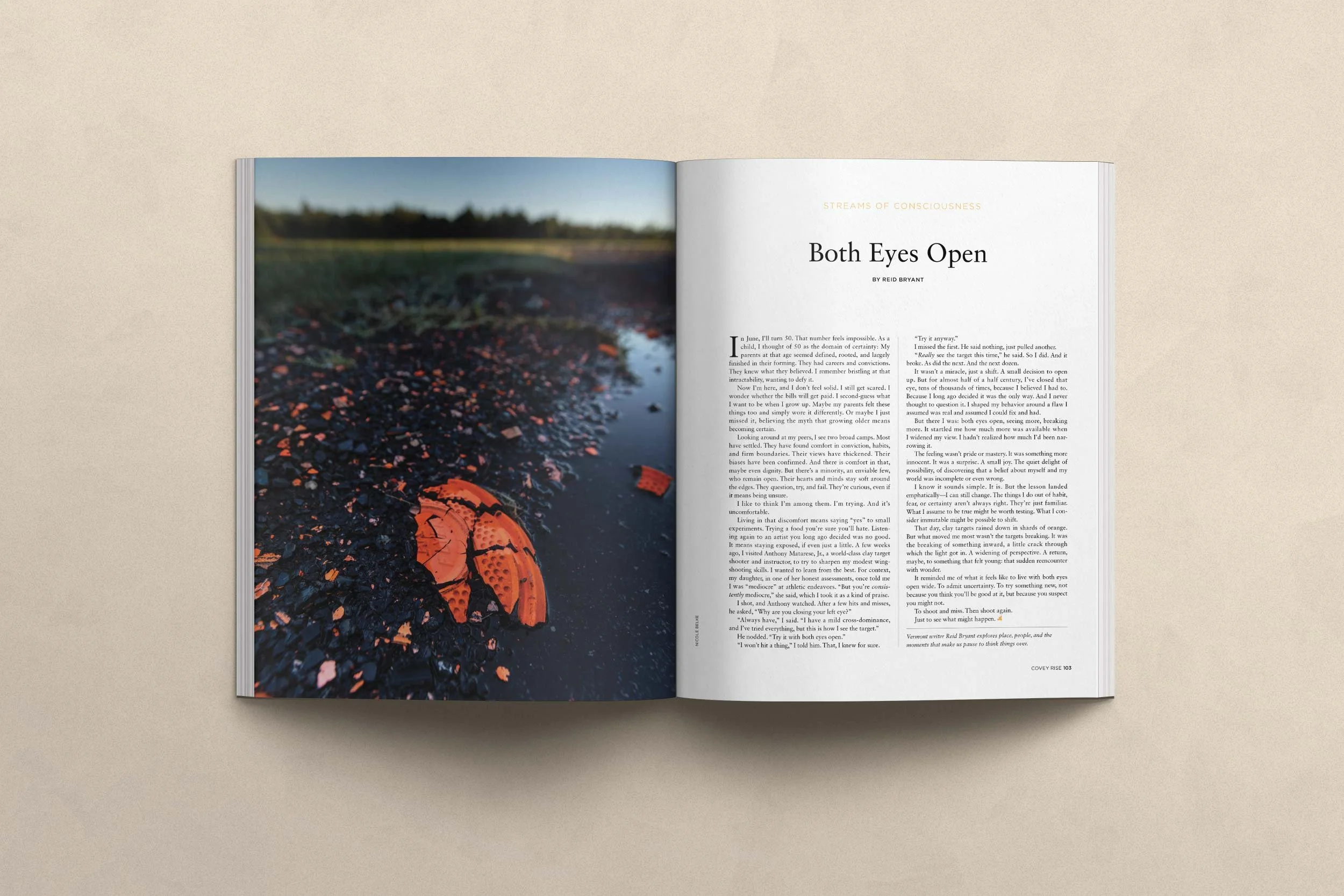
That day, clay targets rained down in shards of orange. But what moved me most wasn’t the targets breaking. It was the breaking of something inward, a little crack through which the light got in. A widening of perspective. A return, maybe, to something that felt young: that sudden reencounter with wonder.
It reminded me of what it feels like to live with both eyes open wide. To admit uncertainty. To try something new not because you think you’ll be good at it, but because you suspect you might not.
To shoot and miss. Then shoot again.
Just to see what might happen.
First Published in Covey Rise Magazine