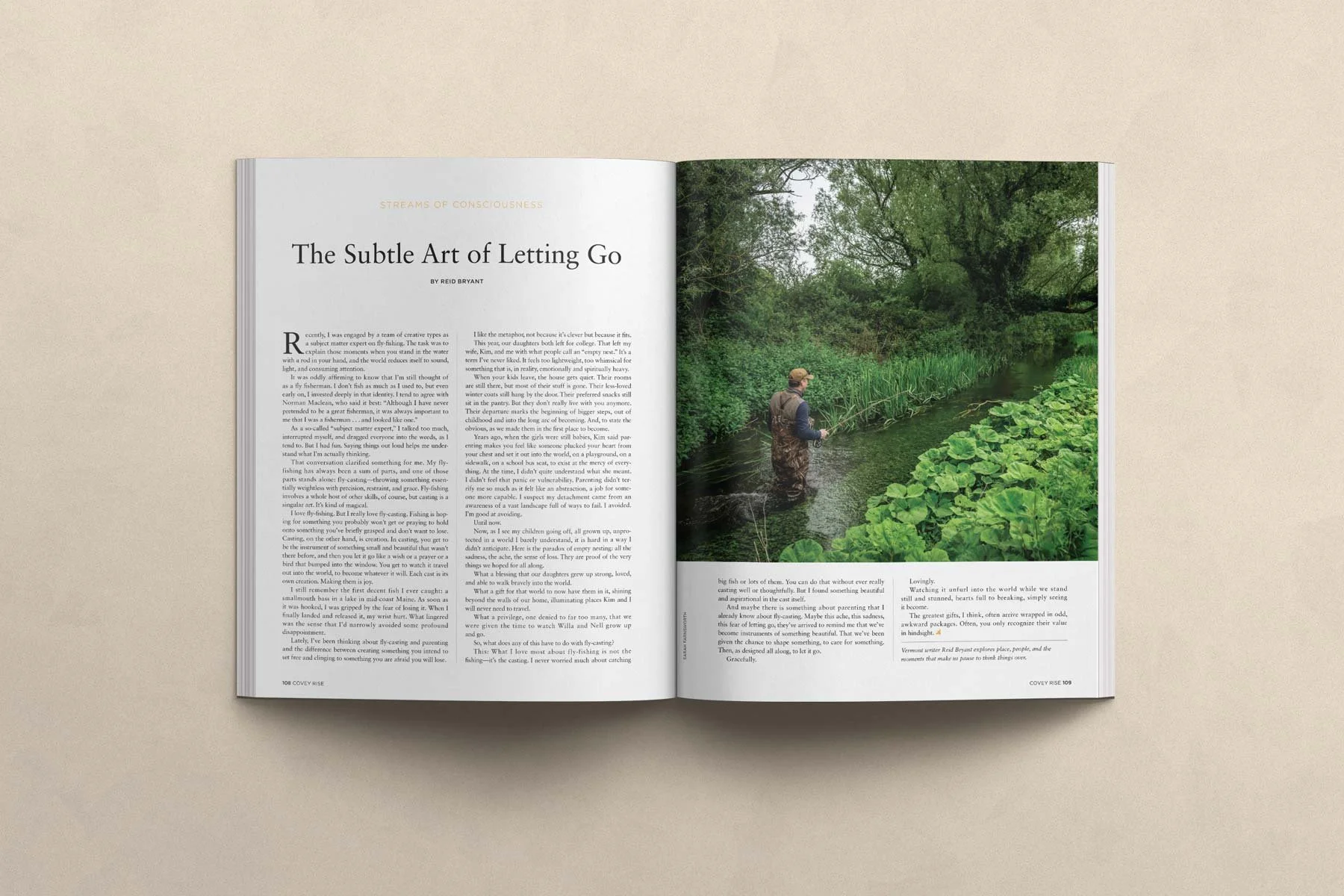
Recently, I was engaged by a team of creative types as a subject matter expert on fly fishing. The task was to explain those moments when you stand in the water with a rod in your hand and the world reduces itself to sound, light, and consuming attention.
It was oddly affirming to know that I’m still thought of as a fly fisher. I don’t fish as much as I used to, but even early on, I invested deeply in that identity. I tend to agree with Norman MacLean, who said it best: “Although I have never pretended to be a great fisherman, it was always important to me that I was a fisherman, and looked like one.”
As a so called SME, I talked too much, interrupted myself, and dragged everyone into the weeds, as I tend to. But I had fun. Saying things out loud helps me understand what I’m actually thinking.
That conversation clarified something for me. My fly fishing has always been a sum of parts, and one of those parts stands alone: fly casting. Throwing something essentially weightless with precision, restraint, and grace. Fly fishing involves a whole host of other skills, of course, but casting is a singular art. It’s kind of magical.
I love fly fishing. But I really love fly casting. Fishing is hoping for something you probably won’t get, or praying to hold onto something you’ve briefly grasped and don’t want to lose. Casting, on the other hand, is creation. In casting you get to be the instrument of something small and beautiful that wasn’t there before, and then you get to let it go, like a wish, or a prayer, or a bird that bumped into the window. You get to watch it travel out into the world, to become whatever it will. Each cast is its own creation. Making them is joy.
I still remember the first decent fish I ever caught, a smallmouth bass in a lake in mid coast Maine. As soon as it was hooked, I was gripped by the fear of losing it. When I finally landed and released it, my wrist hurt. What lingered was the sense that I’d narrowly avoided some profound disappointment.
Lately I’ve been thinking about fly casting, and about parenting, and the difference between creating something you intend to set free and clinging to something you are afraid you will lose. I like the metaphor, not because it’s clever, but because it fits.
This year, our daughters both left for college. That left my wife Kim and me with what people call an “empty nest.” It’s a term I’ve never liked. It feels too lightweight, too whimsical, for something that is, in reality, emotionally and spiritually heavy.
When your kids leave, the house gets quiet. Their rooms are still there, but most of their stuff is gone. Their less loved winter coats still hang by the door. Their preferred snacks still sit in the pantry. But they don’t really live with you anymore. Their departure marks the beginning of bigger steps, out of childhood and into the long arc of becoming. And, to state the obvious, we made them in the first place to become.
Years ago, when the girls were still babies, Kim said that parenting makes you feel like someone plucked your heart from your chest and set it out into the world, on a playground, on a sidewalk, on a school bus seat, to exist at the mercy of everything. At the time, I didn’t quite understand what she meant. I didn’t feel that panic or vulnerability. Parenting didn’t terrify me so much as it felt like an abstraction, a job for someone more capable. I suspect my detachment came from an awareness of a vast landscape full of ways to fail. I avoided. I’m good at avoiding.
Until now.
Now, as I see my children going off, all grown up, unprotected in a world I barely understand, it is hard in a way I didn’t anticipate. Here is the paradox of empty nesting: all the sadness, the ache, the sense of loss, they are proof of the very things we hoped for all along.
What a blessing that our daughters grew up strong, loved, and able to walk bravely into the world.
What a gift for that world to now have them in it, shining beyond the walls of our home, illuminating places Kim and I will never need to travel.
What a privilege, one denied to far too many, that we were given the time to watch Willa and Nell grow up and go.
So what does any of this have to do with fly casting?
This: what I love most about fly fishing is not the fishing, it’s the casting. I never worried much about catching big fish, or lots of them. You can do that without ever really casting well, or thoughtfully. But I found something beautiful and aspirational in the cast itself.
And maybe there is something about parenting that I already know about fly casting. Maybe this ache, this sadness, this fear of letting go, they’ve arrived to remind me that we’ve become instruments of something beautiful. That we’ve been given the chance to shape something, to care for something. Then, as designed all along, to let it go.
Gracefully.
Lovingly.
Watching it unfurl into the world while we stand, still and stunned, hearts full to breaking, simply seeing it become.
The greatest gifts, I think, often arrive wrapped in odd, awkward packages. Often you only recognize their value in hindsight.
First Published in Covey Rise Magazine